Friday, May 15, 2009

This is your victory

Patriots,

This is your victory! It is the victory of the cause of freedom in every land. In all our long history we have never seen a greater day than this. Everyone, man or woman, has done their best. Everyone has tried. Neither the long years, nor the dangers, nor the fierce attacks of the enemy, have in any way weakened the independent resolve of the Lankan nation ...

My dear friends, this is your hour. This is not victory of a party or of any class. It's a victory of the great Sri Lankan nation as a whole. We were the first, in this ancient island, to draw the sword against terrorist tyranny. After a while we were left all alone against the most ruthless and cruel terrorist group that has been seen. We were all alone for year upon year.

Did anyone want to give in? No!

Were we down-hearted? No!

The lights went out and the bombs came down. But every man, woman and child in the country had no thought of quitting the struggle. So we came back, after long months, from the jaws of death, out of the mouth of hell, while the world wondered: 'When shall the reputation and faith of this generation of Lankan men and women fail?' I say that in the long years to come, not only will the people of this island but of the world, wherever the bird of freedom chirps in human hearts, look back to what we've done and they will say: 'Do not despair, do not yield to violence and tyranny, march straightforward and die, if need be, unconquered.'

Now we have emerged from one deadly struggle - a terrible foe has been cast on the ground and awaits our judgment and our mercy - but there is another foe who occupies large portions of the western world, a foe stained with cruelty and greed: the terrorist supporting Tamil Diaspora.

I rejoice that we can all take a night off today, and another day tomorrow. After tomorrow we must begin the task of rebuilding our hearth and homes, doing our utmost to make this country a land in which we all have a chance, in which we all have a duty. And we must turn ourselves to fulfill our duty to our own countrymen, and to our gallant allies in this mighty struggle. We will go hand in hand with them. Even if it is a hard struggle, we will not be the ones who will fail.

Cheers!

Wednesday, May 06, 2009

$20M in Tiger weapons seized


By Stewart Bell
NationalPost.com
, Kilinochchi
May 04, 2009

For a decade, Kilinochchi was a rebel capital, the hub of a vast swath of northern Sri Lanka that was controlled by the Tamil Tigers guerrillas.

In January, the town fell to government troops and now a small Sri Lankan flag flies in the town centre amid idle transit buses, flattened buildings and shuttered shops.

"They never expected us to reach Kilinochchi and capture it," said Lieutenant-General Jagath Dais, commander of the Sri Lankan Army's 57 Division.

"Still they don't believe it."

But the Sri Lankan army got a shock of its own when it began collecting weapons from the fallen rebels: troops seized an astounding array of arms, from assault rifles to artillery guns, even a battle tank.

Almost 100,000 small arms have been seized, the army said, as well as almost one million rounds of ammunition and nearly 30,000 rebel land mines.

"The amount of weaponry has caught us totally, totally by surprise, because we didn't think smuggling in so many weapons was possible," said Palitha Kohona, Sri Lanka's Foreign Secretary.

At two military bases in Kilinochchi, the National Post was shown weapons the army said it had found in the country's northern jungles.

There were 2,700 improvised explosive devices, 6,300 hand grenades and 4,000 bombs, in addition to anti-aircraft guns, artillery guns, mortars, 33 GPS devices and a half-dozen satellite phones.

But small arms were the most common find, particularly T-56 assault rifles, a Chinese-made copy of the notorious Russian Kalashnikov AK-47.

The Sri Lankan government estimates it has captured rebel armaments worth almost $20-million so far. Almost every day, the military announces more weapons seizures.

Some of the weapons are homemade, like a human torpedo that looks like a two-person metal kayak. Others are more sophisticated and could have only come from the global arms market: multi-barreled rocket launchers and surface-to-air missiles.

According to Jane's Intelligence Review, Cambodia has been a significant source of the Tamil Tigers' weapons. The rest have come from places such as North Korea, Afghanistan, Lebanon, Turkey and Ukraine.

The arms broker behind the purchases is alleged to be Kumaran Pathmanadan, better known as simply KP. "Where money is there, weapons are there," said Lt.-Gen. Dais.

Where did the money come from?

The answer is at the heart of police investigations in several countries, including Canada. The RCMP has been looking into the Canadian fundraising operations of the Tamil Tigers since 2002.

A senior member of the Tigers who surrendered two weeks ago said the rebels had misappropriated money sent from abroad for humanitarian aid and reconstruction after the 2004 tsunami.

"These funds have been utilized for military purposes rather than the welfare of the Tamil people," Daya Master said.

Mr. Kohona said foreign aid money has been pumped into northern Sir Lanka, but there is little to show for it on the ground, while the rebels seem to have had no difficulty buying arms.

"They have raised huge amounts of money overseas, whether through voluntary contributions, intimidation or illegal trade activities," the Foreign Secretary said.

The RCMP filed documents in federal court last month alleging the Tamil Tigers had raised money in Canada through an Ontario non-profit organization called the World Tamil Movement.

A police search of the World Tamil Movement offices in Toronto and Montreal turned up letters instructing the group to help raise money in Canada to finance weapons purchases, police said.

The most recent letter was dated 2006, during a faltering ceasefire. It asked for $7-million to finance purchase of anti-aircraft missiles and artillery, according to the RCMP.

RCMP forensic accounting reports allege that, between 2002 and 2006, the World Tamil Movement in Toronto wired almost $3-million to overseas accounts. Most of it went to a bank account in Kuala Lumpur, Malaysia, that is allegedly linked to the Tamil Tigers.

The World Tamil Movement denies the police allegations.

Intercepted telephone calls have placed KP in Malaysia, Mr. Kohona said. His weapons purchases were delivered to rebel-held northern Sri Lanka aboard smuggling ships.

But some of the shipments also passed through the port of Colombo disguised as ordinary cargo, he said.

"Not many sovereign states in the world, including Sri Lanka, have the sophistication to do that sort of thing," he said.

In addition to weapons, the stockpile of seized items includes Tamil Tigers' uniforms and several personal photo albums with pictures of the guerrilla boss Velupillai Prabhakaran and other Tiger leaders, such as the late S.P. Thamilselvan, whose family lives in Toronto.

One photo album contains photos of a young Tamil woman. The pictures show her posing in a red sari at what looks like her wedding, riding a motorbike and standing with another woman, both of them wearing the striped camouflage uniforms of the Tamil Tigers.

There was no indication of her fate.

The whereabouts of four others was more certain. The army seized red boxes bearing their names and photographs. Inside each box was a neatly folded Tamil Tigers flag.

According to the army, such honours are reserved only for dead Black Tigers, members of the rebel suicide squad.

National Post

sbell@nationalpost.com
Thursday, March 19, 2009

Gurkha Cigar - The Rolls-Royce of Cigars

Gurkha Master Select Churchill #5 is my favorite cigar. It's a 7.5 inch, 52 ring gauge cigar, medium to full bodied and complex in flavor. The delicious Gurkha Master’s Select cigars are hand-rolled from fine tobaccos grown in the Cibao Valley of the Dominican Republic, expertly blended with an aged mixture of Nicaraguan, Dominican, and Honduran long-fillers. The gorgeous, dark and silky, Dominican-grown Havana 2000 wrapper imparts a rich, creamy flavor with a hint of spice and pleasant, finish with a burst of flavor.

They arrive in exquisite mahogany boxes of 25 cigars wrapped inside in a sleeve for authenticity. The cigars of each box are tied together in the island fashion; even the limited production boxes are numbered (only 3000 in each size are made). This Cuban look alike is as close as you can legally get to the real thing. And while it may pay tribute to the Cubans of yore, in the opinion of the connoisseurs who smoke it, it’s better. It is indeed the Rolls-Royce of Cigars.

So get a box, light one up with a Gin & Tonic and enjoy the smoke. I have included couple of videos about Gurkha cigars for your viewing pleasure.


Here is a tour of Gurkha Booth at the 2008 IPCPR in Las Vegas. The smooth talking fellow goes over a lot of the type of cigars they make:


Here is a video on how they make Gurkhas:

Cheers!

Monday, March 16, 2009

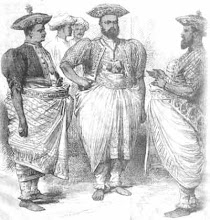
Great Sinhalese King of Kandy: Wimala Dharma Suriya I (Konappu Bandara)

By Chandra Edirisuriya
Sunday Standard
November 12, 2006

"The victory won on the 6th October 1594 was a magnificent achievement. The tactical skill which the experienced eye of Raja Sinha I had detected in Wimala Dharma Suriya or Konappu Bandara as he was then known, had now reached its fruition. Many other brilliant achievement was Wimala Dharma Suriya destined to accomplish against the Portuguese, but on this his first he ever looked back with pride. Wimala Dharma Suriya had followed up his great triumph over Pedro Lopes de Sousa by marrying the Princess Dona Catherina and it was realized that he might prove a more formidable opponent than Raja Sinha I had ever been."

Konappu Bandara who later became the King of Kandy as Wimala Dharma Suriya I (1590-1604), immediately on hearing of his father Wirasundara Mudiyanse's death, fled to Colombo. He was there hospitably received by Dharmapala, the puppet King of Kotte. He married the daughter of Tammita Sembap Perumal or Tammita Rala by whom he appears to have had a child.

Konappu Bandara was one of the Sinhalese officers of the Portuguese. Later having been tried for breaking the law, before Dharmapala and his court he was sentenced to be banished to Goa. He was known to the Portuguese as Dom John of Austria, and also as the Apostate of Candea.

Konappu Bandara the brave warrior was at hand to lead the Sinhalese in person on the expedition to Uda Rata against Raja Sinha I. The reputation which he had won at Colombo had been increased by his success in Goa. A swashbuckler of a Captain was at this time the terror of the place; not even the Viceroy it is said, dared to pass his house sword in hand; and this bully the young Sinhalese had challenged and put to death. He volunteered to join the expedition against the king who had killed his father and his offer was gladly accepted.

Don Philip who was invited by Dom Francisco Wijayakon Mudaliyar to assume the rulership of Kandy over which Raja Sinha lost his hold suddenly died after a few days illness. On the following day his son Dom Joao was proclaimed King but the Sinhalese were not prepared to accept a boy at such a time. Konappu Bandara headed the opposition. In 1593 Raja Sinha invaded the Four Korales and Aritta Kivendu Perumal at the head of a large army advanced to Balane, but found the pass occupied by Konappu in considerable strength. Raja Sinha himself now took the command with a larger force and moving by way of Mawela repeated the attack on Balane and Kadugannawa; but the position was strongly held and he had to withdraw unsuccessful. Konappu Bandara followed and in a battle which ensued Raja Sinha was defeated.

The inhabitants of the hill country acting under the advice of Dewanagala Therunnanse proclaimed Konappu Bandara as their king under the name of Wimala Dharma Suriya.

Portuguese Viceroy of India Mathias de Alboquerque (1591-1597) entertained a dream that in Lanka would be established a second Portuguese nation, which could control the whole of India. The Viceroy's Council arrived at the determination to conquer the whole of Lanka and to place Princess Dona Catherina on the throne of Senkadagala, with a Portuguese as her husband. But the council failed to take notice of the temper of the Sinhalese. Had the princess been married to some Sinhalese noble - Christian if the Portuguese so desired - they would probably still have followed her standard. But it was different when a Conquistador came to fight under the Banner of Portugal and to conquer the Kingdom for a Portuguese fidalgo. The intense pride of race which characterised the Sinhalese, rose in sturdy rebellion against the Portuguese proposal. Rather would they throw in their lot with the one man of their nation who was prepared to lead them in the fight, a mere Appuhami though he was. With the death of Buvaneka Bahu the centre of gravity had shifted from Kotte to Sitawaka, and now with the disappearance of Rajasinghe from the scene it sought its final refuge at Senkadagala and little did the Council appreciate the nature of the opponent they had to deal with. Queyroz describes him as: "Tall of body, with sinewy limbs and great strength, brave, proud of keen intellect, prudent and sagacious, fairly learned, of great military skill and recognized by all as excelling the average of the nation in courage he was a man who never lost his self control or evenness of mind." To his natural courage was added the advantage of military experience won among the Portuguese themselves, with an intimate knowledge of their strength and of their weakness, says Sir Paul E. Pieris in Ceylon the Portuguese Era-Volume I.

The Portuguese had arrived at their determination to conquer the whole country for themselves and to place Princess Dona Catherina the youthful daughter of Karawliyadde Bandara on the throne of Senkadagala, with a Portuguese as her husband. It was also resolved to entrust the execution of their plans to Pedro Lopes de Sousa.

Pedro Lopes de Sousa who was within the sight of the mountains waited for the arrival of the Princess and her escort and then all moved towards the narrow pass of Balane where Wimala Dharma Suriya was stationed. There was some brisk fighting, several of the Portuguese fell, but at last the Sinhalese withdrew beyond the mountains and the Portuguese followed rapidly up to the Mahaweli Ganga, while their rear delayed behind to collect the baggage and to bury the dead. This was on July 5th, 1594.

Wimala Dharma Suriya disappeared into the Wedi Pattu, crossing Wellassa. Senkadagala which he had first set on fire was abandoned and was occupied by the Portuguese the following day - a dreary capital where to install the young Queen.

Aritta Kivendu Perumal who had assumed the name of Jayawira now penetrated into Wellassa and Uwa and returned, bringing as his prisoner the ruler of the latter district, who was related as uncle to Wimala Dharma Suriya. As the King had escaped their hands, the Portuguese satisfied themselves with putting this old man to death.

Matters were not going smoothly with the Portuguese. Luis Moro who was sent on an expedition to Uwa, was captured by the inhabitants and sent to Wimala Dharma Suriya, who ordered him to be executed in satisfaction for the death of his uncle.

Meanwhile a ghastly incident took place where Jayawira was stabbed to death with Jayawira's own golden dagger by the heartless Potuguese General. After the death of Jayawira the Portuguese plundered his treasures, according to some, exceeded one and a half million golds. However, before long the Kandyan army of Wimala Dharma Suriya vanquished the Portuguese invaders. Wimala Dharma Suriya's triumph was complete. Dona Catherina the admitted heiress of Kanda Uda Rata had been captured and was brought to be installed as his principal Queen within the palace ruined by the Portuguese marauders.

One stern but just act of reprisal did Wimala Dharma Suriya commit. A ghastly train of fifty Portuguese staggered into Colombo holding each other by the hand. Their ears were dipped to resemble those of the village curs. There was but one eye left to every five of them. They had been so mutilated as to prevent their increasing the population of their country. This was his characteristic hint that their attentions towards the village maidens were not appreciated. The rest of the prisoners were treated with kindness. They were cured of their wounds and were then employed in reconstructing the palace, temples and fortifications of the capital. They were finally distributed among the Paduwo of the various Royal Gabadagam.

The victory won on the 6th October 1594 was a magnificent achievement. The tactical skill which the experienced eye of Raja Sinha I had detected in Wimala Dharma Suriya or Konappu Bandara as he was then known, had now reached its fruition. Many other brilliant achievement was Wimala Dharma Suriya destined to accomplish against the Portuguese, but on this his first he ever looked back with pride.

Wimala Dharma Suriya had followed up his great triumph over Pedro Lopes de Sousa by marrying the Princess Dona Catherina and it was realized that he might prove a more formidable opponent than Raja Sinha I had ever been. He had full knowledge of the circumstances of the Portuguese and was waiting patiently for them to exhaust themselves in their futile endeavours so as to make himself master of the whole Island with the least degree of danger to himself.

By about the year 1596 nothing was left to the Portuguese save Colombo and Galle. Wimala Dharma Suriya gifted to Edirille Rala the kingdoms of Kotte and Sitawaka with the dignity of a King. Little difficulty was experienced in enrolling a fresh army to accompany the new king. Wimala Dharma Suriya himself took the field with a second army and occupied Menikkadawara.

Wimala Dharma Suriya and his successors fashioned the kingdom to which the name Kanda Uda Rata was given. It consisted of the Four Disawam of Harasiya Pattuwa, Pansiya Pattuwa, Udu Nuwara and Yati Nuwara, the Principalities of Uwa, Matale and Gampola, the Vidanes of Bintenna, Wellassa and Maturata, with the divisions of Panawa, Yala, Kosgama, Madakalapuwa and Kottiyarama, which were administered by Wanniyas. Trincomalee had a separate ruler of its own and with the death of the last of these in the time of Wimala Dharma Suriya that district too was absorbed within the kingdom which thus became territorially the largest in the Island.

The death of King Dharmapala, the puppet king of the Portuguese on 27th May 1957 was an additional stimulus to Wimala Dharma Suriya who alone now represented Sinhalese sovereignty. However Portuguese attacks on his kingdom led by the rapacious Jeromino de Azavedo continued.

Even the inhabitants of the Four and Seven Korales, desperate with the oppression of the Portuguese soldiers addressed to Wimala Dharma Suriya the following piteous appeal.

"We the inhabitants on the frontiers of the Portuguese make known to you, our universal King and victorious Lord of the whole of Lanka, how on every side the robbers of cattle, the shedders of blood, the enemies of our lives, the agents of our captivity, have come on us. We are compelled to surrender to them our possessions, or against our wish to serve them. Wherefore you who are the guardian and protector of this orphaned and afflicted people, have compassion on the unhappy ones, who are in this condition, if you do not desire to see entirely extinguished the nation of which you are the Restorer, guardian, support and firm Protection."

It was in the reign of our hero King Wimala Dharma Suriya I that on the 31st May 1602 two of the Hollanders' ships under the command of Admiral Joris Van Spilbergen cast anchor at the roadstead of the district of Mada Kalapuwa, a short distance from the chief town of Samamanthurai. He was received by the king, with all the rigid formality of an Oriental court and after making his obeisance laid the presents which he had brought on the carpet for Royal inspection. These were then removed within the palace to be shown to the Household, while the King who was dressed in full white, stood up and walked about and conversed with Spilbergen and his companions, after which he gave them permission to withdraw, the Dutch musicians performing on their instruments before they did so.

Vice-Admiral Seebald de Weert who first arrived with another flotilla of the Hollanders met the King on 28th November and it was on a later visit of his that a most unfortunate incident occurred. When De Weent who was under the influence of liquor made a coarse remark regarding the Queen, the irritated Monarch hastily turned his back on the drunken sailor bidding the attendant nobles to "Bind that dog". (Mara isto can in Portuguese). Four men laid hands on him, when de Weert caught his gun, and shouting for assistance attempted to run out of the room. One of the nobles seized him by the hair, while another drew his sword and struck off his head. The King was greatly distressed and sent a curt epistle to the remaining Dutchmen in the ship: "He who drinks wine is vile. God has wrought justice. If you desire peace, it is peace. If war, war." (Que bebem vinho, nao he bem. Deos ha faze justicia. Se quisieres pas, pas. Se quries guerra, guerra.).

Continuous exposure had at last wrought its effect on that frame of steel and frequent attacks of fever warned him that he had not much longer to live. The end was close at hand. Not the coldest waters of Salgaran Oya could any longer allay the burning heat of the fever. The weary King set about placing his house in order. Summoning his ministers to his Chamber he presented them Senerat as the Regent of the Kingdom during the minority of his son Astana Bandara and called upon them to promise him their support and allegiance. The aged chiefs stood silent, the tears trickling down their stern, war-worn faces while the Chief Adigar made the required promise in the name of all. The Queen, still so youthful, and her infant children were next called in and solemnly entrusted to the care and protection of the Regent. And then came the end.

A great pyre was raised, heaped with the richest spices of the East. Thither, to the shrill wailing of the fifes and the roll of the dreary funeral drums, the body was borne, followed by the thousands who knew that fair bearded face and tall figure so well, for they loved him for his open handedness and justice to the poor, says patriot Sir Paul E. Pieris in his epic work 'Ceylon the Portuguese Era' Volume One. In a few hours nothing remained but a heap of ash.

And when they came to remove that ash they found the heart untouched by the fire - that brave and unconquerable heart which had ever beaten for their country.

Wimala Dharma Suriya I was too much of a Statesman to fail to realize that with an Oriental people Religion is the strongest bond of union and that the Buddhist Sinhalese must be ruled by a Buddhist Sovereign, whatever his personal feelings might have been towards Buddhism. His early years were signalized by the repairs of the great fanes of Lanka Tilaka, Gadaladeniya and Attanagalla but it was the reappearance of the Danta Datu which obtained for him the strongest hold over his subjects. A temple was commenced for its occupation and a handsome three-storied structure with a finial of gold and gems soon sheltered the palladium of the Sinhalese. He restored the ordination and Higher Ordination of monks (Upasampada) which the long wars had wiped out from Lanka.

The King personally visited the chief shrines in his Kingdom and when the first Hollanders reached Senkadagala it was a centre of great Buddhist activity. The ambalam which were scattered throughout the country for the convenience of wayfarers were restored by him, "and this famous king built-eighteen towers in diverse places around the great city and united them by a high and thick rampart and set guards in them to defend the city from the enemy. And he freed the whole Kingdom of Lanka from danger," concludes patriotic son of Lanka Sir Paul E. Pieris in paying his grateful tribute to the heroic King that was Wimala Dharma Suriya I of Senkadagala Nuwara or Senkanda Shaila Pura.

Cheers!

Sunday, March 15, 2009

LTTE's Human Shield - a.k.a Civilian Safety Zone

Here is proof positive that LTTE is using the Civilian Safety Zone (CSZ) as a human shield to prevent the SLAF from dropping the kaboom on them. These were obtained by Star SAFIRE II (FLIR) EL/OP Surveillance Cameras (Payload) carried on the Blue HORIZON 2 UAVs of the SLAF.

Image of LTTE positions and trucks next to a civilian water line:


Concealed artillery position and camouflaged LTTE truck in the CSZ:


LTTE truck to transport artillery and food and fuel storage:


LTTE bunkers among civilian tents:


Cheers!

Friday, March 13, 2009

All Blacks 'Ka mate, Ka mate' Haka


This should get any Rugby lovers blood pumping:


The centrality of the haka within All Black rugby tradition is not a recent development. Since the original "All Black" team of "New Zealand Natives" led by Joseph Warbrick the haka has been closely associated with New Zealand rugby. Its mystique has evolved along with the fierce determination, commitment and high level skill which has been the hallmark of New Zealand's National game.

The haka adds a unique component, derived from the indigenous Maori of New Zealand, and which aligns with the wider Polynesian cultures of the Pacific.

The All Blacks perform the haka with precision and intensity which underpin the All Black approach. The first New Zealand rugby team to tour overseas, playing eight matches in New South Wales, Australia, in 1884, performed "a Maori war cry" or haka before each of its matches. The Ka Mate haka was not well known at this time. In 1900, a newspaper reported New Zealand soldiers in the Boer War chanting "Ka Mate! Ka Mate! Koru! Koru! Hae-haea! Ha!" The soldiers thought it meant "Kill him! Chop him up! Baste him!"

But during the 1901 Royal Tour, Ngati Kahungunu warriors revived Ka Mate when they performed it to welcome the Duke of Cornwall at Rotorua. Newspapers described the full actions of this "ancient ngeri," printing its complete Maori words and an accurate translation. A movie cameraman recorded the performance. Ka Mate became famous, and was widely performed throughout New Zealand.

The "Ka Mate" haka generally opens with a set of five preparatory instructions shouted by the leader, before the whole team joins in:

Leader:
Ringa pakia! Slap the hands against the thighs!
Uma tiraha! Puff out the chest!
Turi whatia! Bend the knees!
Hope whai ake! Let the hip follow!
Waewae takahia kia kino! Stamp the feet as hard as you can!

Leader:
Ka mate, ka mate 'I die, I die,
Team: Ka ora' Ka ora' 'I live, 'I live,
Leader: Ka mate, ka mate 'I die, 'I die
Team: Ka ora Ka ora " 'I live, 'I live,

All:
Tēnei te tangata pūhuruhuru This is the hairy man
Nāna i tiki mai whakawhiti te rā ...Who caused the sun to shine again for me
Upane... Upane Up the ladder, Up the ladder
Upane Kaupane" Up to the top
Whiti te rā,! The sun shines!
He! He!

Here is another nice performnace of it in Paris:


Cheers!

Wednesday, March 11, 2009

The Classic Sailing Yacht Aello

Look at the astonishing, legendary, classic sailing yacht Aello.


Aello was designed in 1919 and launched in Hamburg in 1921 by Max Oertz, probably the most famous German shipbuilder of his time. Oertz built the famous imperial schooners Germania and Meteor IV for German Kaiser Wilhelm II. Meteor IV competed against King George's V legendary Britannia and was used as a political tool by the Kaiser. Indeed the Kaiser played an important part in the creation of prestigious yacht clubs and the launching of international regattas.

Aello was created as Meteor's IV sister vessel and is the only remaining large schooner of Max Oertz design in the world. Aello was build for the account of Greek merchant and art lover Antonios Benakis a descendent of an illustrious Greek family of Alexandria, Egypt. Antonios Benakis left behind him a legacy of Museums, art collections and in 1934 founded and became the first president of the Yacht Club of Greece.

Aello was the first yacht member of the Club and to this day one can see engraved on her beautiful bronze wheel the initials of the Yacht Club. When Antonios Benakis decided to move permanently to Greece he made his historic return voyage from Alexandria onboard Aello. After many years of sailing on the Mediterranean Sea, Aello was eventually acquired by a Baron and Admiral of the British Empire who began a lengthy voyage around the world that spanned over many years.

Aello was sold after the World War II and was subsequently abandoned in a mud-berth in England. Although she lay there for nearly four decades, the mud where she rested on had the fortunate characteristic of preserving its hull.

In 1985 Aello's fortunes turned for the better as she was discovered by New Zelander Cameron Chisholm who did not resist to her elegant lines as he saw her laying abandoned in the river. He acquired her and undertook a lengthy restoration that lasted for more than four years and was carried out in Bristol and Southampton by Britain's most skilled craftsmen.

The very wood from which this rare schooner was entirely refitted has a history of its own. Indeed the wood used was salvaged from a vessel that sank in 1917 that was carrying a cargo of Burma teak, an exceptionally rare and beautiful wood. The Burma Teak found in the bowels of the ocean was used to completely rebuild Aello and grant her a new breath of life, bringing her back to her former glory.

Part of her uniqueness stems from the fact that she is the only yacht worldwide that is build entirely, both hull and interior cabinetry, with this precious wood for the last 50 years. After a few voyages to Malta and the Mediterranean, Aello was acquired for a short period of time by an Italian sailing lover who took her to the Caribbean and the Pacific traveling via Panama.

In the 90's Aello found its way to Maine and Fort Lauderdale of Florida, the largest sailing port of the United States as she was acquired by a member of one of American's most famous families of industrialists. There she was groomed and perfected to become the ultimate racehorse, winning many international regattas.

After many voyages on the American coastline and expeditions across the Atlantic to take part in races, Aello founds it way back to Europe.

More than eighty years away from its original home, Aello was at last acquired by a Greek ship owner and art lover who brought her back to Greece were she enjoys her former glory, sailing under the Mediterranean Sea and sun.

Today Aello is the queen of the Mediterranean Sea as she is the only schooner of her size bringing together such history, incredible craftsmanship, speed and unparalleled beauty.


Cheers!